Practical guides built on biomechanics, not tradition
Step-by-step movement guides for desk workers, drawn from published research on seated posture, tissue adaptation, and mobility maintenance.
The five daily movements
These five movements address the primary tissue adaptations caused by sustained sitting. Each one takes approximately two minutes. Together they form a ten-minute daily practice that targets the hip flexors, thoracic spine, cervical spine, shoulder girdle, and posterior chain.
Hip Flexor Lengthening Lunge
Start in a half-kneeling position with one knee on the floor and the other foot forward. Shift your pelvis forward until you feel a stretch through the front of the rear hip. The key detail: tuck your pelvis slightly under rather than letting your lower back arch. Hold for ninety seconds, not thirty. Research on static stretching duration suggests that longer holds produce more durable tissue change than brief ones. Switch sides.
This movement targets the iliopsoas, which is the primary hip flexor shortened by prolonged sitting. It also creates a mild traction effect through the lumbar spine.
Thoracic Extension Over a Rolled Towel
Roll a bath towel lengthwise and place it perpendicular to your spine at approximately mid-back level. Lie back over it with your arms crossed over your chest. Allow gravity to create a gentle extension through the thoracic spine. Move the towel one vertebra at a time, from mid-back toward the upper back. This is a passive mobilization, not a stretch. You're using gravity and a fulcrum rather than muscular effort.
The thoracic spine loses extension range in desk workers over time. This loss is a contributing factor to shoulder impingement and cervical overload.
Cervical Side-Bend with Lateral Neck Release
Sit or stand with your spine tall. Let your right ear move toward your right shoulder without shrugging or rotating. Place your right hand lightly on top of your head, not pulling, just adding the weight of the hand. Hold for sixty seconds. The target tissue is the upper trapezius and scalene group on the left side. Repeat on the other side.
Cervical lateral flexion mobility is often the first range of motion to become restricted in desk workers. The restriction is typically asymmetrical, with one side tighter than the other depending on monitor position and phone habits.
Wall Pec Stretch
Stand facing a wall corner or doorframe. Place one forearm against the wall with your elbow at shoulder height. Rotate your body away from the wall until you feel a stretch through the front of your chest and shoulder. Hold for sixty to ninety seconds. This targets the pectoralis minor, which shortens when the shoulders round forward, a near-universal adaptation in keyboard users.
Pec minor shortening contributes to forward head posture by pulling the shoulder blades into a protracted, anteriorly tilted position. Releasing it changes the resting position of the shoulder girdle.
Standing Hamstring Floss
Stand with one foot elevated on a chair or desk edge, leg straight. Without rounding your lower back, hinge forward from the hip until you feel the hamstring engage. Rather than holding a static position, slowly dorsiflex and plantarflex your ankle while maintaining the hip hinge. This neurodynamic technique targets both the hamstring tissue and the sciatic nerve's mobility in its canal. Ten repetitions per side.
Hamstring tightness in desk workers is partly a tissue adaptation and partly a neural tension pattern. The flossing component addresses both, which is why this movement tends to produce faster results than simple static hamstring stretching.
How to configure your desk so your body doesn't pay for your job
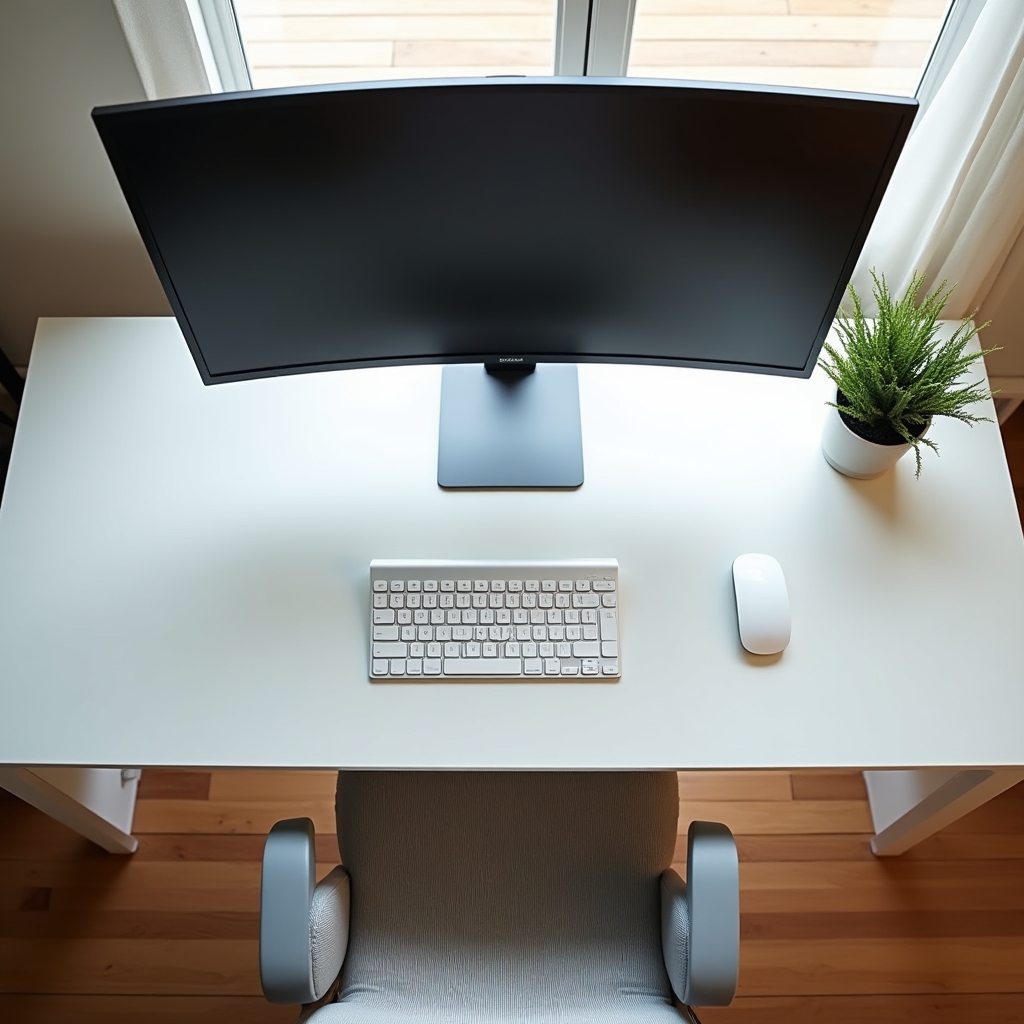
The desk setup variables that matter most are not the ones most commonly discussed. Standing desks get significant attention. Chair lumbar support gets significant attention. But monitor height, keyboard distance, and chair seat depth collectively have a larger effect on daily spinal load than the desk height or the lumbar support foam density.
Monitor height
The top of your monitor should be at or slightly below eye level. Not the center. Not the bottom. The top edge. This position allows your eyes to scan downward to read, which is the natural resting angle of the eye when the neck is in neutral. A monitor that's too low creates sustained cervical flexion. Too high creates sustained extension. Both accumulate load over a workday.
Keyboard distance
Your elbows should be at approximately ninety degrees when your hands are on the keyboard, and your shoulders should not be elevated or protracted to reach it. If your keyboard requires you to reach forward, it's too far away. If your elbows are behind your torso, it's too close. Most people's keyboards are too far forward.
Chair seat depth
There should be two to three finger-widths of space between the front edge of your seat and the back of your knee. A seat that's too deep forces you to either sit without lumbar support or slide forward and lose the chair's back support. This is the most commonly misconfigured chair variable.
Screen distance
Arm's length is the standard recommendation for screen distance. The practical test: if you find yourself leaning forward to read text, the font is too small or the screen is too far away. Increasing font size is a legitimate ergonomic adjustment, not a sign of visual decline.
What foam rolling actually does, and what it doesn't
What the research supports
Foam rolling appears to temporarily increase range of motion and reduce perceived muscle soreness. The mechanism is primarily neurological: pressure on tissue activates mechanoreceptors that reduce muscle tone via the Golgi tendon organ reflex pathway. The effect is real. It's also temporary, typically lasting between five and thirty minutes depending on the tissue and the protocol.
Rolling before exercise may help increase tissue extensibility without the force-production reduction associated with static stretching. This makes it a reasonable addition to a warm-up sequence for that reason specifically.
What the research doesn't support
Foam rolling does not "break up fascia." Fascia is connective tissue with tensile strength comparable to leather. The forces generated by body weight on a foam cylinder are not sufficient to structurally alter it. The "knot-releasing" narrative is mechanistically implausible.
Rolling also does not "flush lactic acid." Lactic acid is metabolized by the liver and heart within minutes of exercise cessation regardless of massage or rolling. The soreness it's credited with reducing is not caused by lactic acid accumulation. The mechanism of delayed onset muscle soreness is inflammatory, not metabolic.